


7 Benefits of 4-Way Stretch Golf Fabric That Change Your Round
Nov 18, 2026
Last Updated: November 17, 2026
Quick Summary
4-way stretch golf fabric stretches both crosswise and lengthwise, then returns to its original shape, so it moves with your shoulders and hips through a full swing instead of fighting them. The benefits show up in three places: mobility through the backswing, comfort across 18 holes, and shape retention after repeated wear.
- Two-way stretch gives only along the crosswise grain, while 4-way stretch adds lengthwise and diagonal give.
- The most reliable blend is roughly 88% to 92% polyester with 8% to 12% spandex.
- Below roughly 5% spandex, fabric recovery weakens noticeably.
- Wash cold, skip fabric softener, and hang dry or tumble on low to protect spandex.
- Stretch a section of fabric, release it, and watch how quickly it springs back to judge recovery.
Table of Contents
- What 4-Way Stretch Golf Fabric Actually Does
- 2-Way vs. 4-Way Stretch Golf Fabric: The Difference You Feel
- How Stretch Fabric Improves Mobility in the Golf Swing
- The Best Material for Golf Pants and Shorts
- Golf Fabric Recovery: Why Shape Retention Matters After 18 Holes
- Golf Shirts for Hot Weather: Breathability and Moisture Management
- Choosing 4-Way Stretch Gear That Works On and Off the Course
- Frequently Asked Questions
What 4-Way Stretch Golf Fabric Actually Does
Four-way stretch golf fabric is a knit performance material that stretches in both directions, crosswise and lengthwise, then returns to its original shape. That two-axis elasticity is what separates it from older two-way fabrics, which only give along the width.
The benefits of 4-way stretch golf fabric show up in three places: mobility through the backswing, comfort across 18 holes, and shape retention after repeated wear. A fabric that stretches on one axis only pulls against you when you rotate. A fabric that stretches on both axes moves with your shoulders and hips instead of fighting them.
Here is the part most shoppers miss. Stretch percentage matters as much as stretch direction. A blend with a small amount of spandex feels flexible on the rack but can sag by the back nine. Construction, fiber content, and recovery all decide whether the stretch holds up.
If you want the full breakdown of how to pick a polo built this way, our guide on how to choose golf polos with four-way stretch walks through fabric weight, fit, and blend ratios.
2-Way vs. 4-Way Stretch Golf Fabric: The Difference You Feel
The difference between 2-way and 4-way stretch comes down to direction. Two-way stretch fabric gives along the crosswise grain, so it flexes side to side but resists movement up and down. Four-way stretch adds lengthwise give, so the fabric moves vertically and diagonally too.
In practice, that means:
- 2-way stretch: comfortable standing still, restrictive at the top of the backswing when your shoulders turn and your arms lift
- 4-way stretch: follows the diagonal path of a golf swing, where rotation and vertical lift happen at the same time
- 2-way stretch: cheaper to produce, common in budget golf apparel, prone to feeling tight across the chest and back
- 4-way stretch: better for unrestricted movement, but only when the spandex percentage and knit construction support recovery
A common mistake is assuming all stretch fabric is equal. A 92% polyester, 8% spandex blend behaves very differently from a light cotton blend with a token amount of elastane. The higher the performance fiber content, the more the garment holds its shape through a round.
How Stretch Fabric Improves Mobility in the Golf Swing

Mobility in the golf swing depends on the fabric letting your body rotate without resistance. The backswing loads your torso and shoulders; the follow-through extends your arms across your body. A stiff garment restricts both, and restriction costs you range of motion at exactly the moment you need it.
Four-way stretch addresses this because the fabric gives on the diagonal, which is the direction a golf swing actually travels. Your lead shoulder drops and turns, your trailing hip clears, and the fabric has to accommodate both at once. Two-way stretch handles one of those movements well and fights the other.
Fit also shapes how much benefit the fabric gives. A four-way stretch polo cut too slim will still bind across the chest, no matter how elastic the material is. Look for a modern fit with room through the shoulders and a hem that stays put when you turn. Performance stretch only works when the garment has space to move.
The Best Material for Golf Pants and Shorts
There is no single best material for golf pants and shorts, but the most reliable starting point is a knit or stretch-woven polyester-spandex blend, typically in the 88% to 92% polyester and 8% to 12% spandex range. That range balances two-axis stretch, quick-dry performance, and enough snap-back to survive a full round. Nylon-spandex blends offer similar stretch with a softer hand and slightly better abrasion resistance. Cotton-heavy blends feel comfortable at rest but recover poorly and hold moisture.
What most buying guides skip is that the same percentage on a label can behave very differently depending on construction. Three variables decide how a four-way stretch golf short or pant actually performs:
- Knit versus woven construction. A knit fabric is built from interlocking loops, so it has inherent stretch and breathability. A stretch woven is denser and more structured, which gives a cleaner drape and better wind resistance but relies more heavily on the spandex for movement. Most performance golf shorts use a stretch woven; most polos use a knit.
- Elastane percentage. Spandex, also called elastane or Lycra, is the fiber that provides stretch and recovery. A 92/8 blend is a common performance ratio; below roughly 5% spandex, recovery weakens noticeably, and above roughly 15%, the garment can feel compressive and run warmer.
- Fabric weight. Measured in grams per square meter (GSM), lighter weights (roughly 130-160 GSM) breathe better in heat, while heavier weights (roughly 180-220 GSM) drape better and resist wind but can feel warm on a humid day.
Here is how the common blends compare on the variables that matter:
| Fabric Blend | Stretch | Breathability | Recovery | Best For |
|---|---|---|---|---|
| Polyester-spandex (92/8) | 4-way | High | Strong | Hot weather, daily wear |
| Nylon-spandex | 4-way | Medium-high | Strong | Soft feel, travel, abrasion resistance |
| Cotton-spandex | 2 to 4-way | Medium | Weak | Casual, low-sweat rounds |
| Polyester only | 2-way or none | High | Moderate | Budget, light use |
For shorts specifically, look for a quick-dry stretch fabric with mesh pocket bags and a cut that clears your knee through the follow-through. Our Coast to Course Performance Golf Short uses a 92% polyester, 8% spandex blend with an 8.5-inch inseam, and is designed to move from the course to the bar.
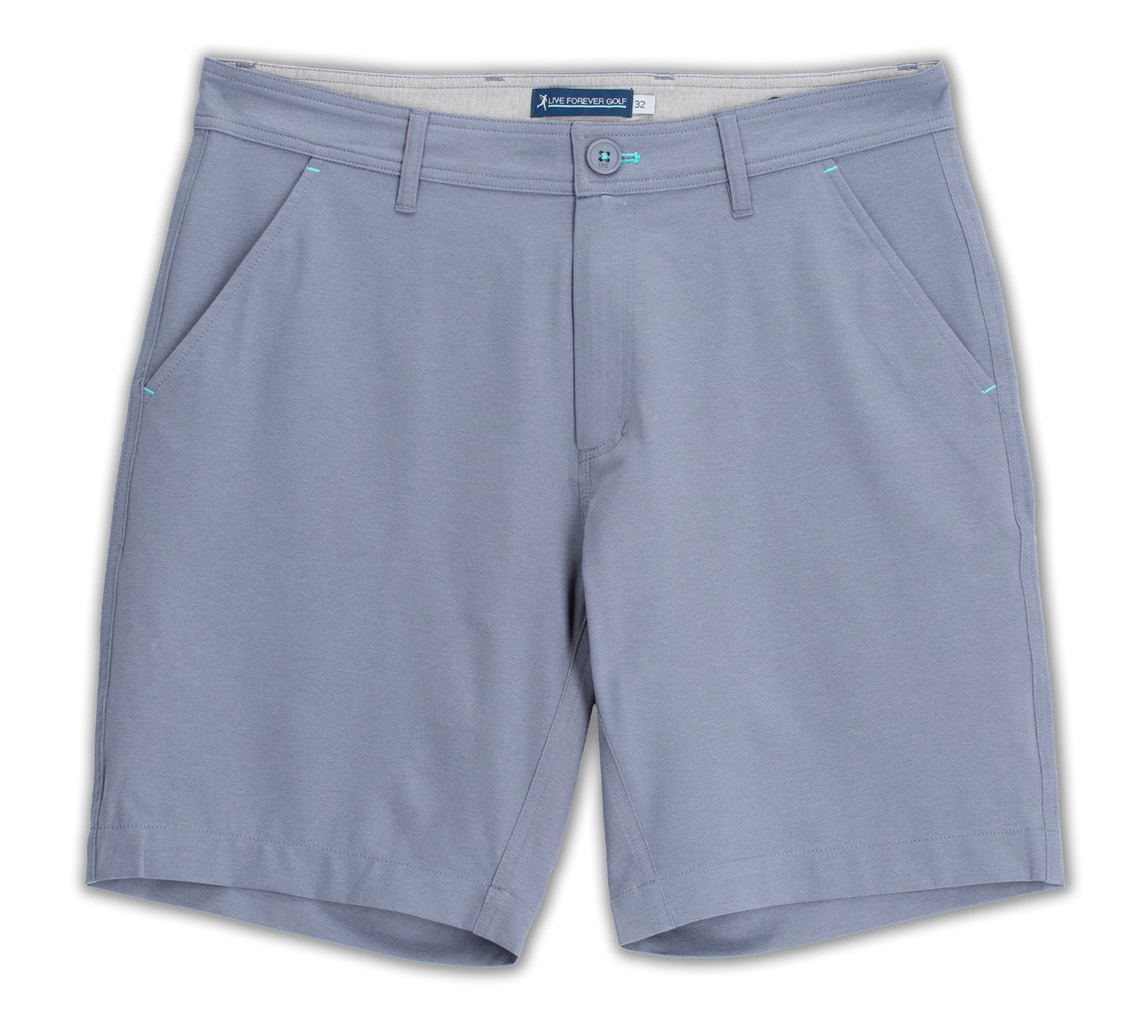
Check recovery, not just initial stretch, and favor a slightly denser weave if you play in wind or cooler mornings.
Golf Fabric Recovery: Why Shape Retention Matters After 18 Holes
Fabric recovery is the ability of a stretched garment to return to its original shape. It is the single most underrated property in golf apparel, and it decides whether your polo still fits on the 18th green the way it did on the first tee.
Stretch and recovery are not the same thing. A fabric can stretch beautifully and recover poorly, which produces sagging elbows, bagging knees, and a stretched-out collar by the end of a round. Elasticity is the stretch; recovery is the snap-back. Spandex content drives recovery, and knit construction supports it.
Signs a garment has weak recovery:
- Elbows and knees stay baggy after you straighten your legs
- The hem loses its shape after a few hours
- The collar rolls or stretches out
- Fabric feels thinner and looser after washing
Care is where most golfers accidentally shorten a garment's life. Heat is the main enemy of spandex: high dryer temperatures and hot washes break down the elastic fiber over time, so the fabric keeps its stretch but loses its snap-back.
A useful way to judge recovery before you buy is a simple manual check: stretch a section of the fabric across the grain, hold it for a few seconds, release it, and watch how quickly it returns.
Care affects recovery too, and recovery affects lifespan. A garment that recovers well holds its fit for years; one that doesn't looks worn out after a season.
Golf Shirts for Hot Weather: Breathability and Moisture Management
Breathability and moisture management are what keep a four-way stretch shirt wearable in heat. Breathable fabric lets air pass through so sweat evaporates; moisture-wicking fabric moves sweat away from your skin to the surface, where it dries fast. Four-way stretch and breathability are not in conflict.
What to look for in a hot-weather golf shirt:
- Lightweight knit: thinner fabric moves air and dries faster
- Moisture-wicking finish: pulls sweat off the skin instead of trapping it
- Odor resistance: keeps the shirt fresh through a sweaty round
- Four-way stretch: lets you swing without the fabric clinging when damp
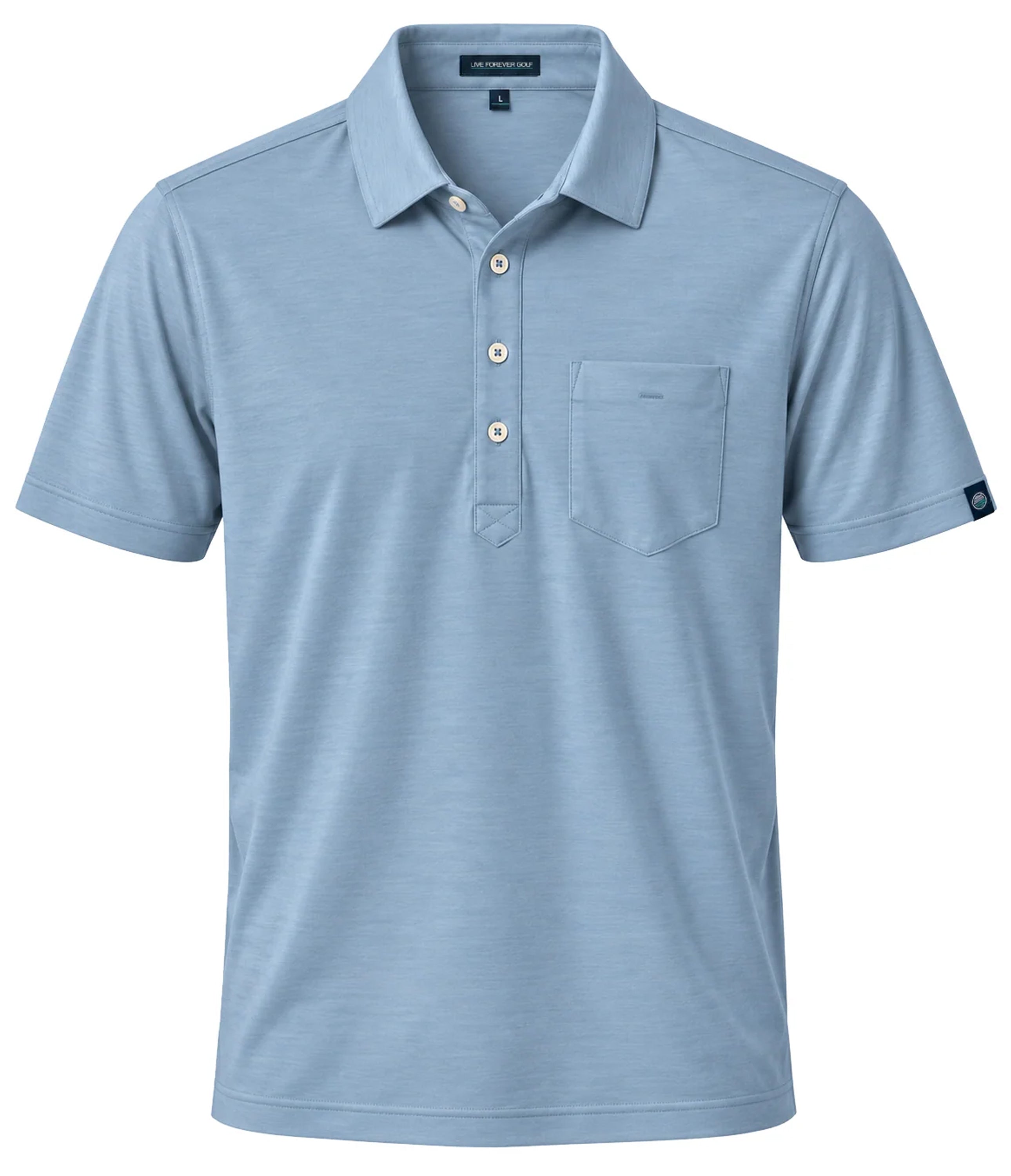
Our The Gamer Polo is built on an 86% drirelease, 11% lyocell, 3% spandex blend that is lightweight and breathable, with moisture-wicking and quick-drying performance. If breathability is your priority, our piece on breathable golf outerwear for mild weather covers how to layer without overheating.
Choosing 4-Way Stretch Gear That Works On and Off the Course
Versatility is where four-way stretch earns its place in a modern wardrobe. A garment built for the swing also works for a drink after the round, a boat day, or a casual dinner, because the same properties that make it move well make it comfortable for hours.
A simple checklist for picking gear that transitions:
- Confirm the fabric is four-way, not two-way stretch
- Check the blend: high performance fiber content for recovery
- Look for moisture-wicking and quick-dry finishes
- Choose a modern fit with room through the shoulders
- Pick colors that read as smart-casual, not just athletic
- Verify care instructions so recovery lasts
Our Micro Stripe Ringer Performance Golf Polo fits this brief with a 92% polyester, 8% spandex blend, a modern true-to-size fit, and a pattern that looks at home on the course or at dinner. If you are ready to build out a wardrobe that moves between settings, see where to buy modern golf apparel that works on and off the course.
The stretch is the foundation. The fit, finish, and color decide whether anyone can tell you came straight from the 18th hole.
The right fabric changes how you swing, how you feel at the turn, and how your gear looks by the time you sit down after the round. Live Forever Golf builds polos and shorts around four-way stretch performance blends, with moisture-wicking finishes, odor resistance, and modern fits designed to move from the course to everything after it. Explore the collection and find gear that plays as well as it looks. Get started with Live Forever Golf and upgrade your round.
Frequently Asked Questions
What are the benefits of 4-way stretch golf fabric?
4-way stretch fabric stretches in both width and length, so it moves with your backswing and follow-through instead of pulling against them. That means less restriction at the shoulders, hips, and waist. It also recovers its shape after stretching, resists bagging at the knees and elbows, and manages moisture better than rigid woven fabrics. For a weekend player, the practical result is a shirt or pant that feels comfortable on the first tee and still fits properly on the 18th green.
What is the difference between 2-way stretch and 4-way stretch fabric?
2-way stretch fabric stretches in one direction, usually across the width. 4-way stretch fabric stretches both crosswise and lengthwise. In a golf swing, that matters because your body moves in multiple directions at once: rotation, side bend, and vertical extension. A 4-way stretch polo or short accommodates all three without binding. 2-way stretch can work for casual wear, but it often limits the follow-through and feels tighter across the back and thighs during play.
Does 4-way stretch fabric retain its shape after washing?
Quality 4-way stretch fabric retains its shape when it contains a resilient elastane or spandex blend and is cared for properly. Look for a spandex content around 3% to 8%, like the 92% polyester / 8% spandex blend used in performance polos. Wash cold, skip the fabric softener, and air dry or tumble low. Heat breaks down elastane over time, which is why performance gear that pills or bags out usually suffered from hot washes and high dryer settings.
Is 4-way stretch golf fabric comfortable in hot weather?
Yes, when the fabric is lightweight and breathable. 4-way stretch itself does not trap heat, but the fiber blend determines how well air moves through the garment. Polyester-spandex blends with a smooth, knit construction wick sweat and dry quickly, while heavier woven fabrics can feel clammy. For hot rounds, choose a polo with moisture-wicking and quick-drying properties, like the Live Forever Golf Ringer polo, and pair it with quick-dry shorts such as the Coast to Course short.
